
Chatbots Suck. AI Guides Don’t — Here’s Why
Why AI Guides win: the four failures of chatbots buyers feel instantly.
On paper, chatbots seemed promising. A 24/7 assistant that could qualify leads, answer questions, and guide top-of-funnel buyers without a rep.
But reality looks different.
Most chatbots are glorified demo-booking pop-ups. They follow rigid scripts, interrupt the buyer journey, offer no depth, and push for sales far too early.
If your chatbot’s first response is “Talk to Sales,” stops at “Get a Demo,” or pops up every five seconds begging for attention, then it’s not helping anyone — least of all your buyers.
There’s a better way to guide people: an experience built around answers, relevance, and personalization.
That’s where AI Guides come in.
What Is an AI Guide?
AI has transformed how people expect to find information. Millions now turn to tools like ChatGPT for instant clarity, not endless navigation.
And outside of work, the pattern is even stronger: Netflix, YouTube, Spotify, Instagram — everything recommends the next best thing automatically.
People no longer browse. They expect to be guided.
Most B2B websites weren’t built for this world. They still rely on:
dropdown menus
resource hubs
long lists of PDFs
static navigation paths
And when buyers have to work to find what they need, they bounce.
Navless fixes that.
Navless is an AI Guide for your website and GTM motions. You can add it to any CMS in seconds so prospects get:
instant answers
personalized content recommendations
a guided path based on their intent
It’s like if Netflix and ChatGPT had a baby — filled with your marketing and sales collateral.
It becomes the shortest, smartest path from curiosity to conversion.
Chatbots vs. AI Guides: The Real Difference
Below is a breakdown of how each experience treats your buyers.
1. How They Start the Conversation
Chatbots
Generic “How can I help you?” prompts and three options that all lead to “Book a Demo.”
It’s not a chat, it’s a disguised form.
AI Guides
They meet the buyer where they are.
They listen, learn, and recommend content based on the buyer’s actual question, not what you hope they ask.
2. How They Handle Questions
Chatbots
Script-based. Easily confused.
Go off-script and you get:
“I’m not sure, but would you like to talk to sales?”
AI Guides
Context-aware.
Pulls the most relevant content from your library (e.g. demos, videos, case studies) and recommends what should come next.
It keeps curiosity moving.
3. How They Build Trust
Chatbots
Interruptive and premature.
They ask for information before the buyer even understands what you do.
AI Guides
They give buyers space to learn.
4. How They Scale
Chatbots
High maintenance.
Requires constant updates, script tuning, and manual routing.
AI Guides
Low lift.
Learns from your existing content. Improves with more assets. Adapts automatically based on buyer behavior.
This is intelligence at scale, not scripts at scale.
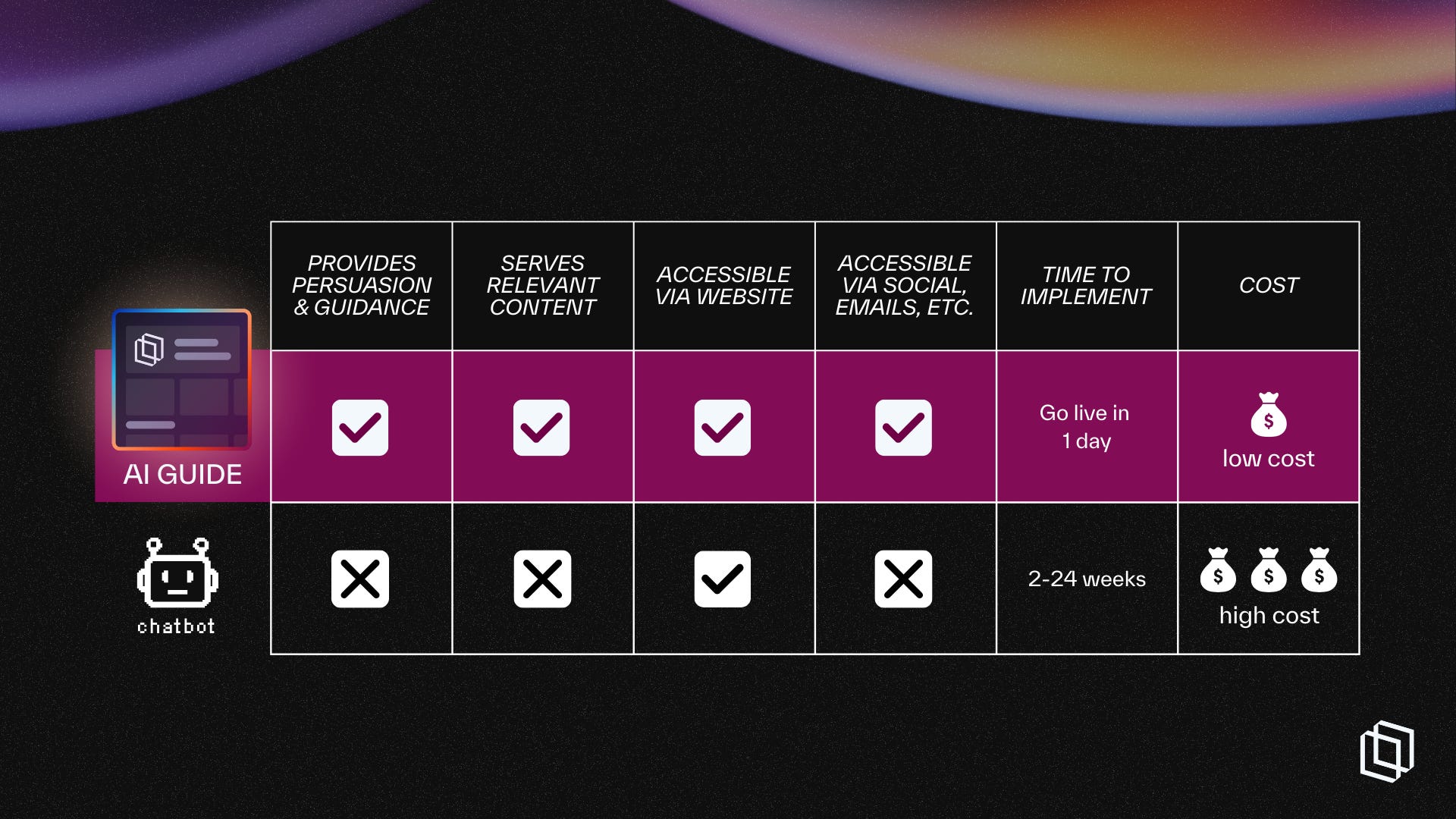
Why the AI Guide Wins
The Takeaway
Chatbots were built for a world where buyers navigated websites the old-fashioned way. AI Guides are built for how people learn today.
If you want to help buyers understand your product faster (not force them into a sales conversation) an AI Guide is the better path.
Chatbots suck. AI Guides help people decide.